For a pivot table that’s based on a Microsoft Access query, you might need to find out which database and query were used as the source data.
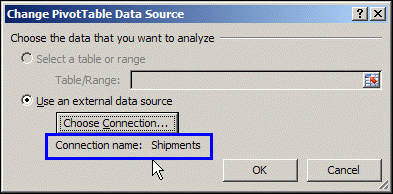
In Excel, if you click the Change Data Source command, on the Ribbon’s Options tab, you can see the connection name in the Change PivotTable Data Source dialog box. However, that bit of information isn’t too useful — it doesn’t show you the name and path of the Access file, and you can’t see which query was used to create the pivot table.
View the Connection Properties
To find the details on the source data’s Access file and query, you can follow these steps:
In the Excel file, select a cell in the pivot table
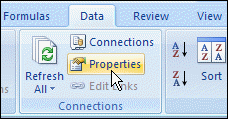
On the Ribbon’s Data tab, in the Connections group, click Properties.
In the Connection Properties dialog box, click the Definition tab.
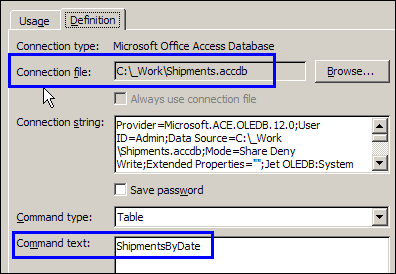
In the Connection File box, you can see the name and path of the database.
In the Command Text box is the name of the Access query.
Click Cancel to close the Connection Properties dialog box.
A powerful feature of pivot tables is that you can filter a pivot field, to see specific results. However, if you apply a different filter to that pivot field, the first filter is removed. For example, if you filter a Row field for region names starting with “East”, and then add a Top 10 filter, the “East” filter is removed.
Use the technique shown in this video to apply multiple pivot table filters at the same time. You can use a Label filter, Value filter and Manual filter simultaneously, to fine tune your pivot table reports.
If you’re interested in learning how to use Microsoft PowerPivot for Excel 2010, here is a bargain for you.
There’s a special price today on the ebook version of Microsoft PowerPivot for Excel 2010: Give Your Data Meaning, by Mark Russo and Alberto Ferrari.
Here’s the tweet that announced the special price:
#Ebook Deal of the Day: Microsoft PowerPivot for Excel 2010 – $14.99 (Save 46%) Code DDPVT
The link in that tweet takes you to the O’Reilly page, where it shows the full price. Just click the “Add to Cart” button for the Ebook version, and enter the special code (DDPVT).
Newer Version
Update: There is a newer version of this book available now — Microsoft Excel 2013 Building Data Models with PowerPivot
If you love the new PowerPivot add-in for Excel 2010, you can enter the latest contest on the PowerPivotPro blog.
Show off your efficient PowerPivot techniques, and win one of the two top prizes — a 1 year MSDN subscription.
Send in your sample workbooks, with charts and slicers and cross-filtering enabled. Impress Rob with your PowerPivot skills, and you might win one of the top prizes, or a PowerPivot poster.
Here’s how Rob will decide the winner:
Entries will be judged on, in roughly descending order:
Performance – I will compare query speed with slicer cross-filtering turned on vs. turned off. Smaller differences are better for this contest.
Polish – as I slice the report, do the charts all still look nice? Ex: Blank space in charts = not good.
Ease – how hard is it to execute your technique? We will turn winning entries into blog posts, and this will become a new reference technique here at PowerPivotPro.
Originality – this never hurts but is not crucial. Fun is good. Unexpected benefits and features are even better.
I don’t see a closing date for the contest, so you’d better get started soon, and send in your entry ASAP.
Update: Contest closes Sunday October 3, 2010, at 11:59 PM US Pacific time
If your pivot table is based on a large data source, it might respond very slowly when you add fields or move fields to a different area of the pivot table.
To improve performance, try the following tips:
Remove any pivot table styles and any other formatting, such as conditional formatting that you applied to the pivot table.
Calculated items can negatively impact the speed of updating. If possible, remove any fields that contain calculated items, or delete the calculated items from the fields.
Defer Layout Update
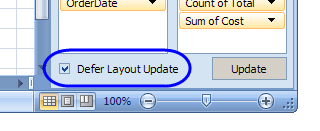
If you plan to add or move more than one field, you can use the Defer Layout Update option. When this feature is enabled, the fields are all added or moved, and then the pivot table is recalculated once. If this box is not checked, the pivot table is recalculated after each field is added or moved.
To defer the layout updates:
Add a check mark to the Defer Layout Update box in the PivotTable Field List.
Move or all all the fields that you want to adjust
Click the Update button, to the right of the Defer Layout Update check box.
When you’re finished changing the layout, remove the check mark from the Defer Layout Update check box.
Note: Some features, such as filtering and grouping, are not available when Defer Layout Update is activated.
In Excel 2010, you can use the free PowerPivot add-in to create a report from multiple Excel workbooks or worksheets. With PowerPivot, it’s easy to connect the tables using the Primary and the Foreign key, such as ‘ProductID’ in a Sales table and a Pricing table.
In some cases though, you might want to combine the data in two Excel files, or worksheets, that have an identical structure. For example, you could have sales data for the different regions, or expense data for multiple years.
Because the tables have identical structures, you can’t use a key to connect them; instead, you would need to create one combined table from all the data. The technique shown in the following video allows you to import more than a million records from Excel, despite the fact that one worksheet can only contain up to 1,048,576 rows.
To see detailed instructions for this technique, with more screen shots, visit the PowerPivot from Identical Structure Excel Files page on the Contextures website. That page also has a link for downloading the East and West sales data that I used in this example.
Watch the PowerPivot Video
To see the steps for combining data from multiple tables in PowerPivot, please watch this video.
Download the PowerPivot Add-In
You can download the free PowerPivot add-in from the Microsoft website: PowerPivot Download
If you’re working with pivot table calculated fields in Excel VBA programming, or trying to use the Orientation property for data fields, you might encounter some problems. Here’s how I managed to work around an error that occurs for a pivot table calculated field removed with Excel VBA.
To create a pivot table from data on different worksheets, you can use a Multiple Consolidation Ranges pivot table, but the result is a pivot table with limited features and functionality.
Now Kirill has expanded that technique, and written a macro to build a pivot table from data in multiple Excel files.
Pivot Table Macro
In Kirill’s example, the main file is named Report.xls. It contains the pivot table code, and a button that runs the macro. After you start the macro, it prompts you to select one or more data files, all stored in the same folder.
All of the data files must have the same structure, and the macro pulls the data stored on Sheet1 in each file.
Standard Pivot Table
The macro creates a standard pivot table based on a Union query, and not built from Multiple Consolidation Ranges, it’s a fully functioning pivot table, and you can pivot, group and filter the data, as usual. You can also refresh the pivot table, to show the latest data in the source files, as long as those files stay in their original location.
The Union Query
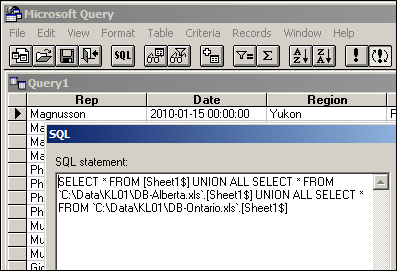
Kirill’s macro creates a Union query to combine the data from all the selected files. If you open Microsoft Query, you can see the SQL string for the Union query, and all the data from the selected workbooks.
Download the Sample File
You can download the Pivot Workbooks example to see the sample code and create the pivot table. The zipped folder that contains the Report.xls file, and the five sample data files. Unzip the folder, and keep all the files in the same folder. When you open the Report.xls file, enable macros to run the code.
In Excel 2007, when you create a second pivot table from the same source data, you don’t get an option to base the new pivot table on an existing pivot table, the way you can in Excel 2003.
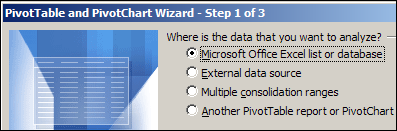
In Step 1 of the Excel 2003 Wizard, you can select the first option, to create an independent pivot table. Or, select the fourth option, for pivot tables that share the same pivot cache.
In Excel 2007, if you create two pivot tables from the same source data, they automatically use the same pivot cache of the source data. You don’t have an option to create an independent pivot table.
Grouping Problems
Because the pivot tables share the same cache, this can cause problems if you group the data in the pivot fields.
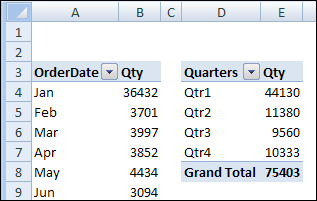
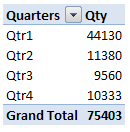
When you change the grouping in one pivot table, the same grouping appears in the other pivot table. For example, change the date grouping in the first pivot table to Months, and the dates in the second pivot table automatically group in Months.
Because you created the two pivot tables from the same source data, by default they use the same pivot cache, which is where the grouping is stored.
However, you might want different grouping in the two pivot tables. For example, you’d like Month grouping in one pivot table, and Quarter grouping in the other.
Create a Second Pivot Cache
To use different grouping in each pivot table, you’ll need to create a separate pivot cache for each pivot table. Use the following easy method, suggested in the Excel newsgroups by Dave Peterson.
To create a separate pivot cache for the second pivot table:
Cut the second pivot table, and paste it into a new workbook.
Change the grouping of the second pivot table.
Cut the second pivot table from the new workbook, and paste it back into the original workbook.
Now there are two pivot caches in the original workbook, and each pivot table can be grouped independently.
Watch the Video
To see the steps for creating a second pivot cache so you can create separate grouping in the pivot tables, please watch this Excel video tutorial.
Previously, we’ve looked at the pivot table summary functions: Count, Average, Min and Max and Product. In this article we’ll look at the StdDev and StdDevp summary functions.
StdDev Function and StdDevp Function
Like the STDEV.P and STDEV.S worksheet functions, the StdDev and StdDevp summary functions calculate the standard deviation for the underlying data in the Values area, and is the square root of the variance. Like the variance, standard deviation is a measure of how widely the values vary from the average of the values.
The StdDevp summary function is used when the entire population is used in the calculation. If a sample of the data is used, instead of the entire population, then use the StdDev summary function.
STDEV.P Worksheet Function
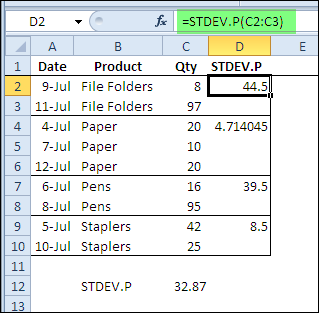
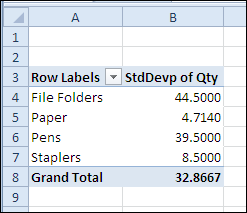
Shown below is the pivot table source data, and the STDEV.P worksheet function is calculating the standard deviation for each product type. There is a large difference between the quantities of file folders sold, and the standard deviation is 44.5. For the paper sales, the difference in quantity is much smaller, and the standard deviation is only 4.71.
Pivot Table StdDevp Summary Function
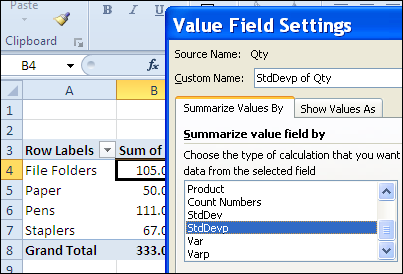
To use the StdDevp summary function, when the Qty field is added to the pivot table, change the summary calculation to StdDevp.
The standard deviations shown in the pivot table are the same as those that were calculated on the worksheet.
Note: If the count of items is one, a #DIV/0! error is displayed when using the StdDev summary function, because one is subtracted from the count when calculating the standard deviation.
How the Standard Deviation is calculated
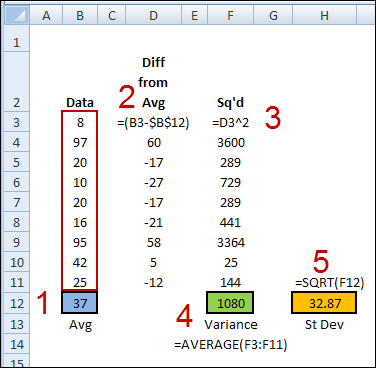
In the standard deviation, each number is compared to the mean of the numbers. If you were to calculate the standard deviation on the worksheet, without the STDEV.P function, here’s how you would do it.
Find the average of the numbers in the pivot table data.

 If you love the new PowerPivot add-in for Excel 2010, you can enter the latest contest on the PowerPivotPro blog.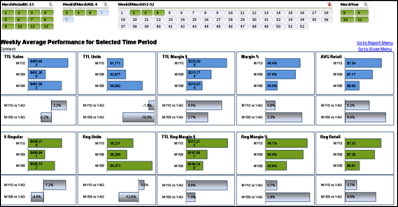

 In Excel 2007, when you create a second pivot table from the same source data, you don’t get an option to base the new pivot table on an existing pivot table, the way you can in Excel 2003.